
The Climate Signals We’re Ignoring—and Why Forests Are at the Centre of All of Them
From land-use change to wildfires and wetlands, climate signals show why forests and afforestation must be treated as core climate infrastructure.
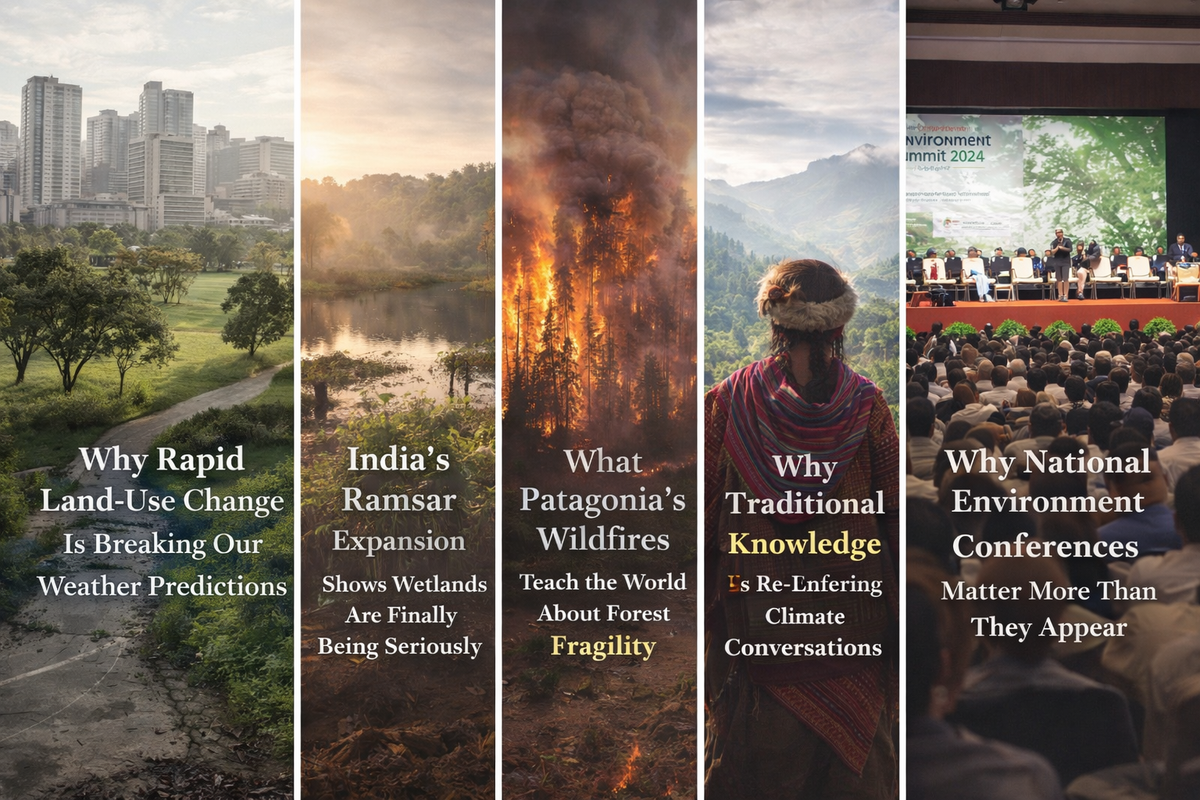
Across the world and in India, climate signals are becoming harder to ignore. Weather models are struggling. Wetlands are disappearing faster than forests. Wildfires are turning once-stable ecosystems into ash. At the same time, governments and communities are gathering in conferences and campaigns, trying to respond.
At first glance, these may look like separate stories. They are not.
They are all symptoms of the same underlying issue: we have treated ecosystems as secondary infrastructure for far too long.
When Land Changes Faster Than Climate Models
Scientists in India have warned that rapid land-use change—driven by urbanisation, deforestation, and shrinking green cover—is now affecting the accuracy of weather forecasts.
Trees, soil, and vegetation are not passive background elements in climate systems. They regulate heat, moisture, wind flow, and rainfall. When land cover changes abruptly, climate models lose key inputs, making extreme events harder to predict.
This is a critical but overlooked truth: afforestation and land restoration are not just climate solutions—they are climate data stabilisers.
Without stable ecosystems, even the best climate science becomes less reliable.
Wetlands Are Finally Getting Attention—But Time Is Short
India’s rapid expansion of Ramsar-recognised wetlands—from 26 sites a decade ago to nearly 100—signals growing awareness that wetlands are essential climate assets.
Wetlands store carbon, regulate floods, recharge groundwater, and support biodiversity. Yet globally, they are disappearing faster than forests.
This matters deeply for afforestation. Tree planting efforts that ignore wetlands, hydrology, and water cycles often fail. Healthy forests depend on healthy water systems.
Protecting wetlands is not a parallel effort to afforestation—it is foundational to it.

Wildfires Are Teaching the Hardest Lessons
Recent wildfires in Patagonia have burned tens of thousands of hectares of pristine forest. These were not marginal landscapes. They were ecosystems once considered resilient.
The causes are familiar: rising temperatures, prolonged droughts, weakened forest protection systems, and climate stress.
The lesson is clear and uncomfortable:
planting trees without long-term protection, diversity, and landscape planning creates fragile forests.
Afforestation that stops at planting is not resilience.
Resilience comes from:
- Species diversity
- Fire-aware land management
- Community stewardship
- Long-term funding and monitoring
Forests take decades to grow and days to burn.
Why Traditional Knowledge Is Returning to Climate Conversations
Global discussions around wetlands and ecosystems are increasingly recognising the role of indigenous and traditional knowledge systems.
Communities that have lived with forests, wetlands, and grasslands for generations understand seasonal cycles, water behaviour, and land resilience in ways modern systems often overlook.
Many afforestation failures stem from ignoring this knowledge—planting the wrong species, disrupting water balance, or excluding local custodians.
Climate solutions that exclude people rarely last.
Ecosystem restoration that includes them often does.
Conferences, Campaigns, and the Missing Link
National and global environment conferences may not make headlines, but they reflect a quiet shift: climate action is moving from isolated projects to systems thinking.
Forests, wetlands, land use, climate modelling, biodiversity, and communities are finally being discussed together—not separately.
This matters because afforestation cannot succeed in isolation. Trees interact with water, soil, climate, and people. Treating them as standalone carbon tools weakens their impact.
The Bigger Picture
All these signals point to one conclusion:
- Climate models are struggling because ecosystems are unstable
- Wetlands are vanishing while forests are stressed
- Fires are exposing the fragility of poorly managed forests
- Communities and traditional knowledge are returning to the centre of solutions
Afforestation, done right, can help address all of these.
Done wrong, it becomes another short-term distraction.
A Final Thought
Trees are not offsets.
Forests are not numbers.
Ecosystems are not optional.
They are climate infrastructure.
At Afforestation.org, we believe the future of climate action depends on whether we stop treating nature as a side project—and start restoring it as the foundation it has always been.
Comments ()