
Supreme Court Backs Assam’s Forest Protection Mechanism: What It Means for Trees, Ecosystems and Climate Action
India’s Supreme Court approves Assam’s mechanism to remove forest encroachers with due process. Learn why this matters for afforestation, forest protection, and climate resilience.
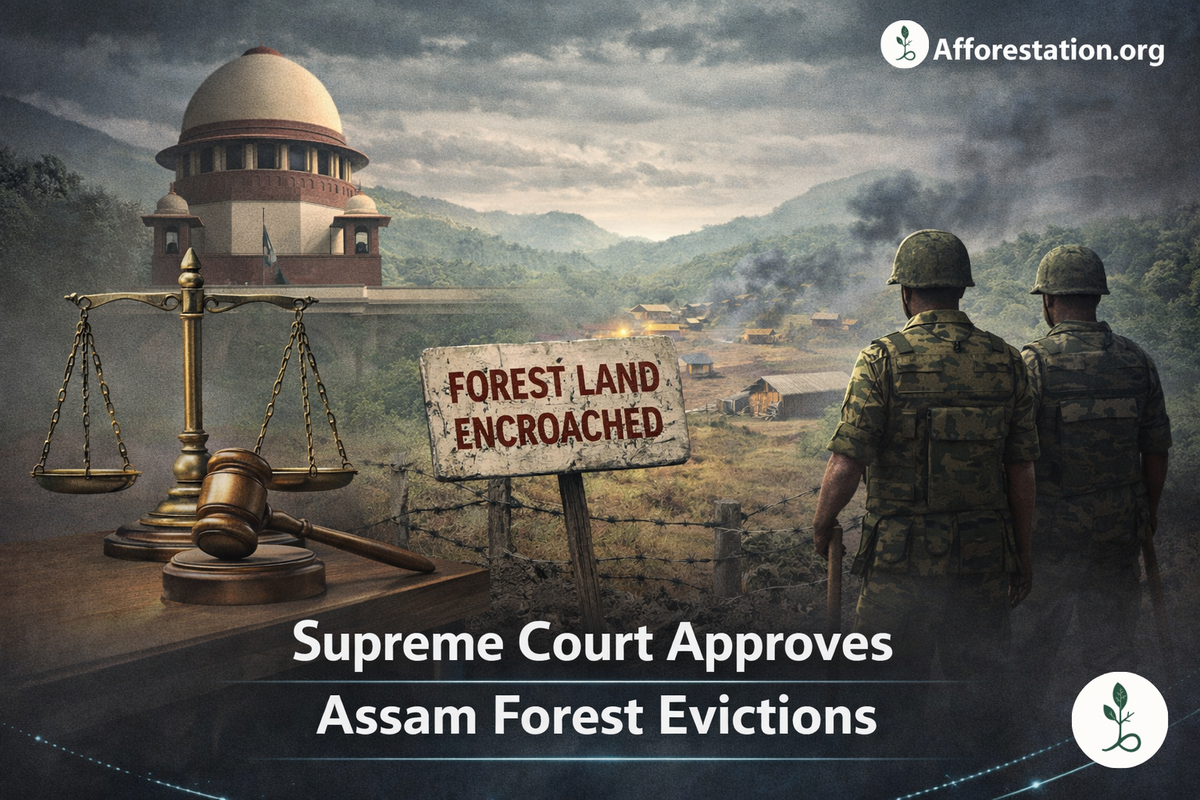
In a significant development for forest governance in India, the Supreme Court has approved a structured mechanism proposed by the Assam government to evict encroachers from forest lands, while ensuring procedural safeguards and due process.
According to reports by LiveLaw and Scroll.in, the Court upheld the state’s eviction framework as legally sound and consistent with principles of fairness and environmental protection.
This decision comes at a critical time when forest encroachment continues to threaten biodiversity, climate resilience, and long-term ecological stability in Assam.

What the Supreme Court Approved
As reported by LiveLaw (February 10), a bench of Justices P.S. Narasimha and Alok Aradhe approved the mechanism that allows Assam to proceed with eviction in reserved forest areas, subject to safeguards.
The mechanism includes:
- A joint committee of forest and revenue officials to examine claims
- Opportunity for occupants to present documentary evidence
- Issuance of speaking orders before eviction
- A mandatory 15-day notice period before removal
Scroll.in further reported that the Court emphasised that any eviction must follow due process and cannot be arbitrary.
This framework seeks to balance environmental protection with constitutional safeguards.
Sources:
- LiveLaw – “Supreme Court Approves Assam Govt Mechanism To Evict Encroachers From Forest Lands”
- Scroll.in – “Supreme Court Approves Assam Mechanism To Evict Alleged Encroachers Of Forest Land”
Why Assam’s Forest Land Is Under Pressure
Reports by India Today NE indicate that large areas of Assam’s reserved forests remain under encroachment, affecting ecological integrity and forest cover.
Encroachment not only fragments wildlife habitats but also:
- Reduces carbon sequestration capacity
- Increases flood vulnerability
- Accelerates soil erosion
- Weakens biodiversity corridors
Forest land diversion — whether legal or illegal — directly impacts India’s climate goals.
Why This Ruling Matters for Afforestation
1️⃣ Legal Clarity Enables Ecological Restoration
Afforestation cannot succeed on land that is legally disputed or under occupation. Restoration efforts require:
- Clear land title
- Defined forest boundaries
- Governance accountability
The Court’s approval provides a legal foundation upon which ecological restoration can be built.
2️⃣ Protection Must Precede Plantation
Tree planting alone does not solve forest degradation. Protecting existing forest land is far more impactful than compensating for its loss later.
Forest protection:
- Preserves mature carbon sinks
- Protects native biodiversity
- Maintains ecosystem services
Afforestation must complement — not replace — conservation.
3️⃣ Technology Can Ensure Transparency After Eviction
Once forest land is restored to state control, the next challenge begins: ensuring it is regenerated and protected long-term.
This is where digital monitoring and ecosystem intelligence platforms become critical.
With tools such as:
- Satellite imagery tracking
- Geo-tagged plantation verification
- Survival rate dashboards
- Public transparency portals
- Long-term canopy growth mapping
Afforestation can move from symbolic action to measurable ecological recovery.
At Afforestation.org, we believe that combining legal enforcement with digital transparency is the only way to ensure forest restoration is successful in reality — not just in policy documents.
The Bigger Governance Shift
India’s Constitution places environmental protection at the core of governance:
- Article 48A: The State shall protect and improve the environment and safeguard forests.
- Article 51A(g): It is the duty of every citizen to protect and improve the natural environment.
The Supreme Court’s ruling reinforces that forest land is not merely a resource — it is a public ecological asset.
But enforcement alone is not enough. It must be followed by:
- Restoration planning
- Ecological assessment
- Transparent monitoring
- Community participation
Only then can forest land recovery translate into climate resilience.
Conclusion
The Supreme Court’s approval of Assam’s forest eviction mechanism marks an important step toward stronger forest governance.
Yet the real test lies ahead.
Clearing encroachment is only the beginning. The success of this decision will depend on whether the reclaimed forest lands are:
- Scientifically restored
- Digitally monitored
- Transparently managed
- Protected for future generations
Afforestation must evolve from counting saplings to building ecosystems — supported by law, data, and long-term accountability.
News Sources Referenced
- LiveLaw – Supreme Court Approves Assam Govt Mechanism To Evict Encroachers From Forest Lands
- Scroll.in – Supreme Court Approves Assam Mechanism To Evict Alleged Encroachers
- India Today NE – Supreme Court Verdict Empowers Assam To Fast-Track Forest Land Evictions


Comments ()