
Aravalli Conservation Gets a Major Boost — Can Restoration Finally Outpace Degradation?
Rajasthan’s ₹130 crore Aravalli restoration plan signals renewed commitment to forest protection. But real success will depend on ecological precision, transparency, and long-term monitoring.
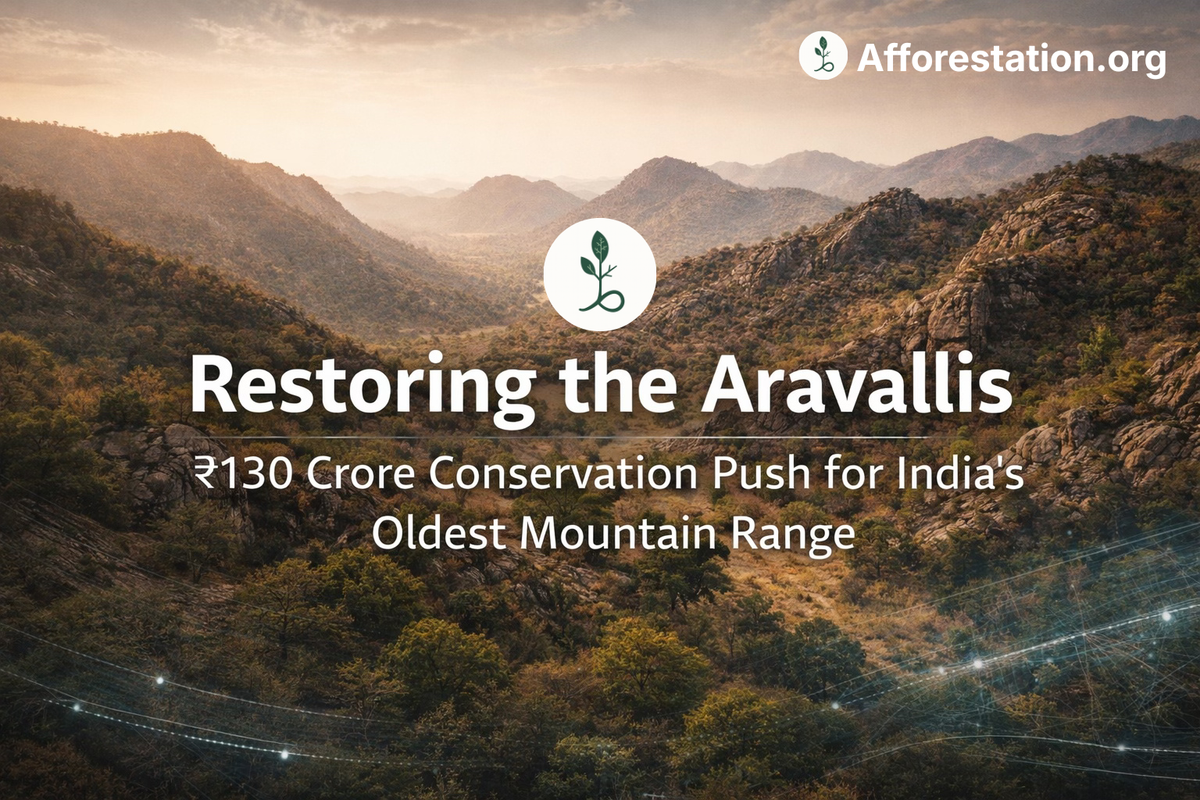
The Aravalli range is one of the oldest mountain systems in the world — older than the Himalayas and deeply embedded in India’s ecological history. Stretching across Rajasthan, Haryana, and Gujarat, the Aravallis act as a natural barrier against desertification, regulate groundwater recharge, and provide habitat for countless species.
Rajasthan recently announced a ₹130 crore conservation and restoration plan aimed at protecting and revitalising approximately 4,000 hectares of the Aravalli landscape.
The announcement signals political recognition of the ecological importance of this fragile region. But the true measure of success will depend not on allocation size — but on implementation quality.

Why the Aravallis Matter
The Aravallis are not just hills; they are:
- A natural shield preventing the Thar Desert from expanding eastward
- A key groundwater recharge zone for Rajasthan and parts of Delhi NCR
- A biodiversity corridor supporting leopards, hyenas, birds, and native vegetation
- A climate stabiliser in one of India’s driest regions
Over decades, illegal mining, land encroachment, fragmentation, and urban expansion have severely weakened the range. The ecological stress has contributed to water scarcity, rising heat intensity, and habitat loss.
Restoration is not optional. It is urgent.
What the New Plan Includes
The conservation strategy reportedly includes:
- Large-scale tree plantation efforts
- Water conservation measures
- Strengthening protection against illegal mining
- Establishment of “Namo Van” nurseries
- Pilot programs exploring carbon credit ratings
These elements reflect a more integrated restoration approach compared to isolated plantation drives.
Importantly, the inclusion of water conservation is critical — because afforestation in semi-arid landscapes cannot succeed without soil moisture management.
The Risk: Plantation Without Ecosystem Strategy
While plantation commitments generate visibility, Aravalli restoration demands ecological precision.
Key risks include:
- Planting non-native or water-intensive species
- Ignoring grassland ecosystems that are equally important
- Focusing on tree counts instead of survival and biodiversity
- Failing to address fragmentation and mining enforcement
The Aravallis are ecologically unique. A one-size-fits-all plantation model could unintentionally damage native ecosystems.
True restoration must prioritise:
- Native, drought-resistant species
- Soil stabilisation and erosion control
- Landscape-level planning
- Wildlife corridor preservation
- Long-term monitoring beyond 2–3 years
Why Monitoring and Transparency Will Decide Success
Large public conservation investments require public accountability.
For this initiative to succeed in reality — not just on paper — the following mechanisms are essential:
Satellite Monitoring
Regular canopy and land-use change mapping to ensure planted areas are intact and not re-diverted.
Survival Rate Reporting
Public dashboards showing 3-year, 5-year, and 10-year survival rates of plantations.
Biodiversity Metrics
Tracking species diversity, regeneration rates, and ecological stability — not just plantation area.
Water Table Impact Tracking
Monitoring whether restoration efforts improve groundwater recharge over time.
Digital forest intelligence platforms can integrate these layers into a unified transparency system.
Without measurable indicators, restoration risks becoming symbolic.
The Carbon Credit Opportunity — With Caution
The mention of carbon credit rating pilots introduces both opportunity and responsibility.
If done correctly:
- Carbon markets can finance long-term restoration
- Communities can benefit from ecosystem stewardship
- Climate mitigation goals can align with conservation
However, carbon accounting must reflect:
- Actual biomass growth
- Long-term permanence
- Ecological integrity
Carbon credit schemes that ignore biodiversity or water impact could undermine ecological goals.
A Critical Moment for the Aravallis
The Aravalli range has suffered decades of degradation. The new conservation funding marks an opportunity to reverse that trajectory.
But restoration in fragile landscapes is not a short-term campaign. It is a multi-decade commitment requiring:
- Strong governance
- Transparent implementation
- Ecological science
- Community integration
- Technology-backed monitoring
If implemented with rigor, this initiative could become a model for semi-arid landscape restoration across India.
If implemented superficially, it risks becoming another well-intentioned but short-lived intervention.
Conclusion
The ₹130 crore Aravalli conservation plan is a welcome and necessary step. The range is too important — ecologically and climatically — to ignore.
But success will not be measured in press releases or plantation targets.
It will be measured in:
- Stable groundwater levels
- Reduced erosion
- Increased canopy continuity
- Biodiversity return
- Long-term ecosystem resilience
Afforestation in the Aravallis must be smart, transparent, and ecosystem-specific.
Because restoring one of the world’s oldest mountain ranges requires more than planting trees. It requires rebuilding systems.
Comments ()